Don't miss our Offers - up to 50% OFF!

White Duck Crochet Pattern: Long-Neck Charm with a Pink Hat
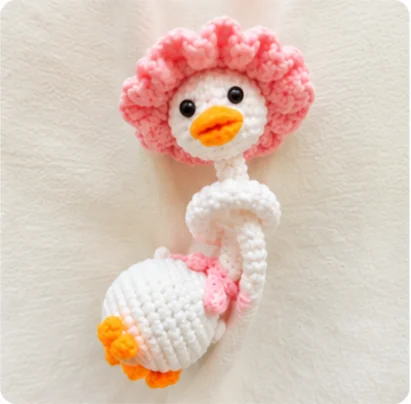
This white duck crochet pattern combines a little round head, a slender bendable neck and a plump body with an orange beak and feet. The pink ruffled hat frames the face, while a short scarf and tiny wings complete the character. It is a playful decorative project from the Long-Neck Animal Charms collection.
Follow the white duck crochet pattern from the head down through the neck and body, then add the separate hat, beak, scarf, wings and feet. The guide includes round tables, original reference photos and explicit count notes wherever the printed shaping sequences conflict with their stated totals.
White Duck Crochet Pattern: Materials and Project Checklist
The white duck crochet pattern covers the Little White Duck only. The collection cover also shows a yellow duck, frog, goose and two chicken variations, but their individual instructions are not included in this guide. Prepare the small separate pieces before you begin final assembly.
| Supply | What to prepare |
|---|---|
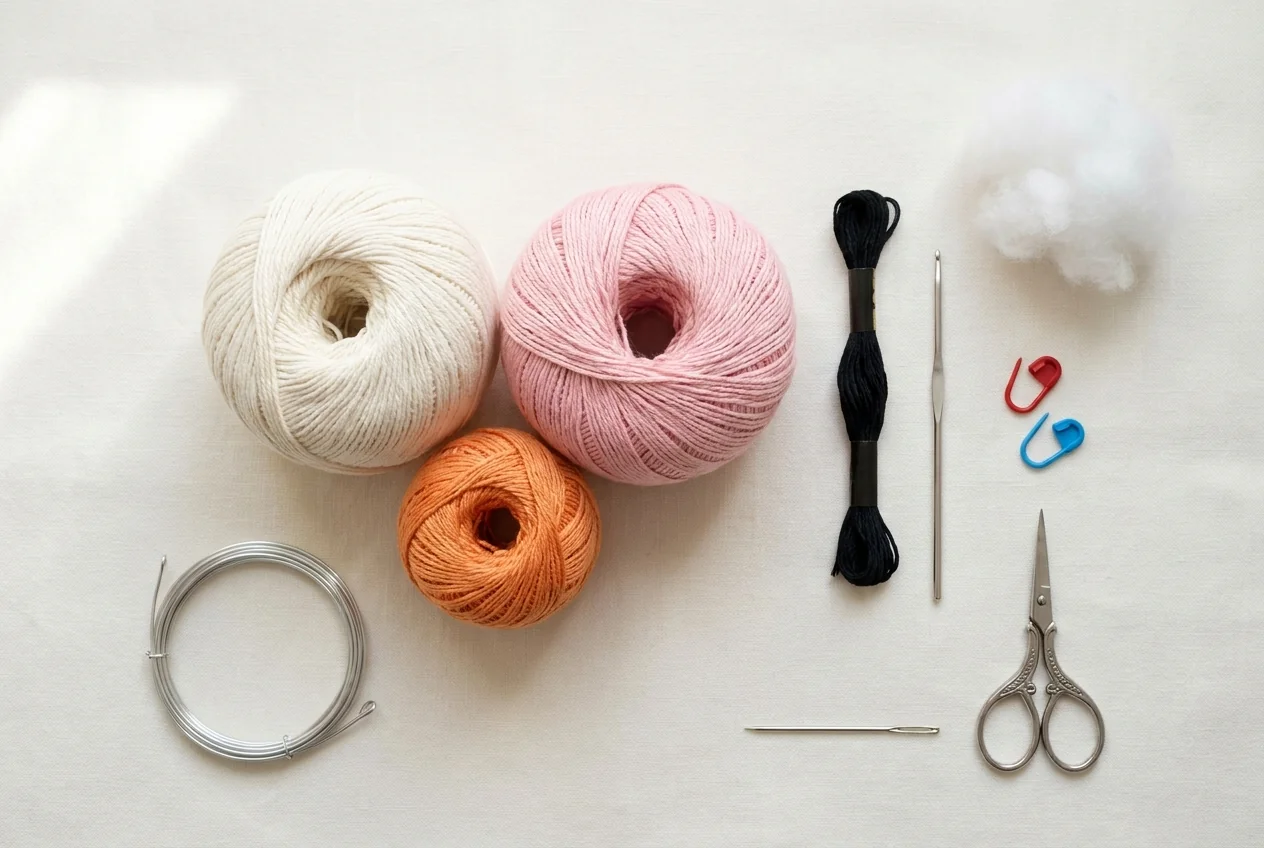
| Yarn | 4-ply milk cotton in white or cream, pink and orange; a little black embroidery yarn if choosing stitched pupils. |
| Hook | 1.8 mm for the Little White Duck, according to the supplied color chart. |
| Stuffing | Polyester fiberfill for the head and body. Leave the wired neck unstuffed. |
| Support | 1.0 mm craft wire and suitable tools for safely cutting and enclosing the ends. |
| Eyes | 4.0 mm safety eyes from the general materials list, or black embroidered eyes. |
| Tools | Stitch marker, tapestry needle, scissors and temporary placement markers. |
For the white duck crochet pattern, match the thickness of all yarn colors. “4-ply milk cotton” is not the same as US weight-4 yarn and does not establish a universal gauge. Your fabric should hold stuffing without obvious gaps; change the hook if needed, while recognizing that any change affects the final proportions.
- Make 1 continuous head–neck–body piece in white.
- Make 1 pink hat, 1 orange beak and 1 short scarf.
- Make 2 wings and 2 feet; use the original photographs for placement.
- Keep a separate neck-round tally and leave long tails on the pieces that need sewing.
The white duck crochet pattern does not supply a verified finished measurement or yarn amount. Make and measure a sample before claiming a particular size. For a related project, explore the long-neck goose guide or browse more ideas on Universe Crochet.
White Duck Crochet Pattern: Stitches and Joined Rounds
| Term | US meaning |
|---|---|
| MR | Magic ring. |
| ch / sl st | Chain / slip stitch. |
| sc | Single crochet. |
| hdc | Half double crochet: yarn over, draw up a loop, yarn over and pull through all 3 loops. |
| dc | Double crochet: yarn over, draw up a loop, then pull through 2 loops twice. |
| inc | 2 sc into the same stitch. |
| dec | Single crochet the next 2 stitches together. |
| FLO | Front loops only. |
| […] × N | Repeat the bracketed sequence N times. |
| (N) / * | End-of-round stitch total / an editorial count alternative. |
Work the white duck crochet pattern in joined rounds. End each round with a sl st into its first sc and begin the next with ch 1. Neither the chain nor the joining slip stitch counts. Do not turn the round work, and keep a marker in the first actual stitch.
- Make a magic ring, ch 1 and work the stated sc into the adjustable loop. Pull the tail snug and join to the first sc.
- At the next round, work into the first actual stitch, not into the joining slip stitch. Count before you join.
- For a decrease, draw up a loop in each of the next 2 stitches, yarn over and pull through all 3 loops.
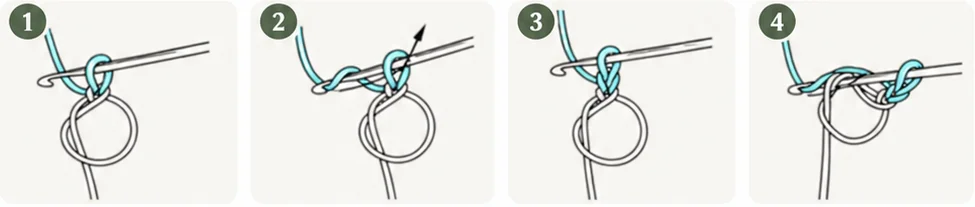

In the white duck crochet pattern, square brackets followed by × 6 mean six complete repeats. A plain range such as rounds 6–7 means work the same stated round twice. The final-count column is a checkpoint, not a reason to force an inconsistent source repeat to fit.
Step 1: White Duck Crochet Pattern — Head and Eyes
Start the white duck crochet pattern at the top of the head with white yarn. The head expands to 24 stitches, then narrows to a six-stitch opening for the neck. Several source lines do not match those transitions; the starred alternatives below keep the printed final totals.
| Rnd | Instructions | Count |
|---|---|---|
| 1 | MR, 6 sc; pull tight; sl st to first sc. | 6 |
| 2 | Ch 1, 6 inc; sl st. | 12 |
| 3* | Ch 1, [sc, inc] × 6; sl st. | 18 |
| 4 | Ch 1, 18 sc; sl st. | 18 |
| 5* | Ch 1, [2 sc, inc] × 6; sl st. | 24 |
| 6–7 | Ch 1, 24 sc; sl st in each round. | 24 |
| 8* | Ch 1, [2 sc, dec] × 6; sl st. | 18 |
| 9* | Ch 1, [sc, dec] × 6; sl st. | 12 |
| 10* | Ch 1, [2 sc, dec] × 3; sl st. | 9 |
| 11* | Ch 1, [sc, dec] × 3; sl st. | 6 |
Plan the eyes before the opening becomes narrow
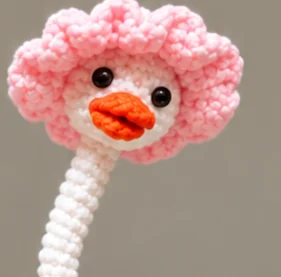
The white duck crochet pattern specifies three stitches between the eyes, but no numbered eye-placement round. Pin the face on the front of the head, leave three untouched stitches between the insertion points, and compare both sides before securing the pupils. Plan space for the beak below the eyes.
If using safety eyes in the white duck crochet pattern, secure each matching washer while you can still reach the inside, before stuffing and closing the head. The source lists eye attachment during final assembly, but that order makes washer access impractical. Do not try to push a washer through the finished six-stitch neck.
For embroidered eyes, mark matching positions and use small secure black stitches. Add fiberfill while the head opening is still accessible, before the last narrowing rounds; this is practical editorial timing rather than a new round. Shape the head evenly and keep the future neck tube clear.
Step 2: White Duck Crochet Pattern — Long Neck
Continue the white duck crochet pattern with the same white yarn. Rounds 12–50: ch 1, 6 sc, sl st in every round. That is 39 plain neck rounds; round 11 is the decrease that creates the six-stitch tube and is not part of the plain-round tally.
- Keep a separate tally for all 39 neck rounds.
- Leave the neck unstuffed when using the wire support, following the general instructions.
- Count six actual sc in each round; the setup chain and join do not add stitches.
- Continue directly into body round 51 without fastening off.
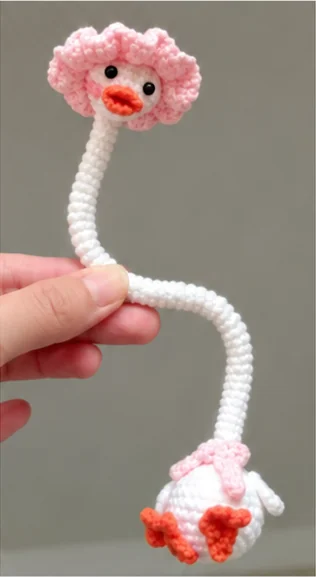
The white duck crochet pattern permits a different neck length but gives no tested alternative round count. Keep 39 rounds for the first sample. Extra rounds change the balance, the support length and the display curve; they do not guarantee a secure fit around a particular bag handle.
Step 3: White Duck Crochet Pattern — Body and Closure
The white duck crochet pattern now widens from six stitches to a 32-stitch body before decreasing to eight. Keep working in white. The shaping sequences below are arithmetic-consistent editorial readings, not confirmed reconstructions of the intended increase or decrease placement.
| Rnd | Instructions | Count |
|---|---|---|
| 51* | Ch 1, [2 sc, inc] × 2; sl st. | 8 |
| 52* | Ch 1, [sc, inc] × 4; sl st. | 12 |
| 53* | Ch 1, [sc, inc] × 6; sl st. | 18 |
| 54* | Ch 1, [2 sc, inc] × 6; sl st. | 24 |
| 55 | Ch 1, 24 sc; sl st. | 24 |
| 56* | Ch 1, [5 sc, inc] × 4; sl st. | 28 |
| 57* | Ch 1, [6 sc, inc] × 4; sl st. | 32 |
| 58 | Ch 1, 32 sc; sl st. | 32 |
| 59* | Ch 1, [6 sc, dec] × 4; sl st. | 28 |
| 60* | Ch 1, [5 sc, dec] × 4; sl st. | 24 |
| 61* | Ch 1, [2 sc, dec] × 6; sl st. | 18 |
| 62* | Ch 1, [sc, dec] × 6; sl st. | 12 |
| 63* | Ch 1, [sc, dec] × 4; sl st. | 8 |
Add filling and enclose the neck support
Before the white duck crochet pattern body opening becomes too small, add fiberfill and plan access for the wire. After round 60 is a practical checkpoint because 24 stitches remain. This earlier stuffing/support timing is editorial guidance; the supplied body lines do not give a detailed insertion stage.
The source specifies 1.0 mm craft wire but no cut length or anchoring diagram for the white duck crochet pattern. Measure against your actual tube, allow for enclosed ends and use suitable tools to turn or cap every cut end. Guide the prepared support gently through the unstuffed neck; never force a sharp end through the head or yarn.
Keep the body rounded rather than hard. Finish the decreases only after checking that the support is enclosed and cannot press against the stitches. After round 63, fasten off with a long tail. The source passes a sewing needle through the outer loops of every other remaining stitch, then pulls tight to close.
With eight remaining stitches, that source closure catches four alternate loops. Inspect the result carefully. If a gap remains, reinforcing it with the sewing tail through the remaining edge loops is an editorial finishing option, not an extra decrease round. Secure the tail and bury it inside the body.
Step 4: White Duck Crochet Pattern — Pink Ruffled Hat
Make the hat separately in pink for the white duck crochet pattern. Its first seven rounds form the cap. The final round works three dc into each front loop to create the ruffle. Unlike the main-piece shaping, these printed hat counts are internally consistent.
| Rnd | Instructions | Count |
|---|---|---|
| 1 | MR, 6 sc; pull tight; sl st. | 6 |
| 2 | Ch 1, 6 inc; sl st. | 12 |
| 3 | Ch 1, [sc, inc] × 6; sl st. | 18 |
| 4 | Ch 1, [sc, inc, sc] × 6; sl st. | 24 |
| 5–7 | Ch 1, 24 sc; sl st in each of these 3 rounds. | 24 |
| 8 | Ch 1, work 3 dc in the FLO of every stitch; sl st to first actual dc. | 72 |
In the white duck crochet pattern hat brim, the starting ch 1 follows the source and does not count as a dc. Work three dc into each of the 24 front loops: 24 × 3 = 72 dc. Do not work only three dc in the first stitch and then one dc around the rest.
Fasten off and weave in the ends. Place the cap over the head with its ruffle framing the face, then check that the brim does not cover the eyes. The white duck crochet pattern gives no numbered hat attachment round; pin the fit before sewing it securely to the head.
Step 5: White Duck Crochet Pattern — Orange Beak
Use orange yarn for the beak in the white duck crochet pattern. It is worked into one magic ring with two repeats of [ch 2, 2 hdc, ch 2, sl st]. Both repeats go into that same adjustable ring, not into separate chains or a second foundation.
- Make a magic ring and hold it open.
- Ch 2, work 2 hdc into the ring, ch 2 and sl st into the ring. This completes the first lobe.
- Without cutting the yarn, repeat: ch 2, 2 hdc into the same ring, ch 2, sl st into the ring.
- Pull the ring tight, secure the ring tail and leave a tail for sewing. Arrange the two lobes and pin the beak below the eyes before attaching it.
The white duck crochet pattern supplies no final conventional sc-round count for this beak. The two repeats contain four hdc in total, plus their chain arches and slip stitches. Do not reinterpret the instruction as four hdc spread around the head itself; the beak is a separate little piece.
Step 6: White Duck Crochet Pattern — Short Scarf
The written white duck crochet pattern specifies white yarn for the scarf. Ch 26, then from the second chain from the hook work 25 sc. This is one straight row. Fasten off and weave in the ends; no additional scarf rows, border or fringe are supplied.
Wrap the scarf around the neck and cross the ends at the front, following the assembly directions. Tack the crossing in place with a few secure stitches if needed; the tacking method is an editorial finishing suggestion. Keep the neck visible rather than tightening the scarf against the support.
Some white duck crochet pattern photos show a pink tie near the body and a white loop at the neck. No separate pink-bow instructions are supplied. A pink scarf would be a color variation of the same 25-sc strip, not proof that an additional bow piece is included.
Step 7: White Duck Crochet Pattern — Make Two Wings
Use white yarn for the two wings, following the white duck crochet pattern photographs. The printed instruction is: ch 5; from the second chain, sl st, 2 sc, 3 sc in the last chain, 2 sc, sl st. To fit that sequence, the return stitches need the opposite side of the foundation chain.
- Ch 5. From the second chain from the hook, work 1 sl st, then 1 sc into each of the next 2 chains.
- Work 3 sc into the last chain to turn around the end.
- Continue along the unused side of the same foundation: 1 sc into each of the next 2 positions, then sl st into the final end position.
- Fasten off with a sewing tail and make a second matching wing.
The opposite-side route in the white duck crochet pattern wing is an editorial clarification; the source lists the stitches but does not explicitly name the return side. The sequence uses seven sc and two sl st overall. It is a small unstuffed wing, not a filled amigurumi tube.

Step 8: White Duck Crochet Pattern — Make Two Feet
For each foot in the white duck crochet pattern, ch 8; from the second chain, work 2 sc, then 5 sl st. Those seven worked positions use all seven available chains. Fasten off with a sewing tail. Make the second foot to match, using orange as shown in the original photographs.
Pin both written-version feet to the bottom of the white duck crochet pattern body, compare their length and direction, and sew the attachment ends securely. Do not invent extra chains or branched toes and present them as confirmed source instructions. Sample the placement before finishing the second foot seam.
Step 9: White Duck Crochet Pattern — Assembly and Care
Lay out the white duck crochet pattern components before sewing: one main piece, hat, beak, scarf, two wings and two feet. The eyes should already be secured if using plastic parts. The original assembly gives three stitches between the eyes but no numerical placement for the other pieces.
- Check the head filling, body closure and wire enclosure before adding the small details.
- Attach the orange beak below the eyes. Check the front view before fastening the sewing tail.
- Sew the pink hat to the top of the head, keeping the ruffle clear of the pupils.
- Pin one wing to each side of the body and compare their height and angle. Sew both securely.
- Attach the two feet to the bottom of the body using the written-version strips, or obtain the missing shaping before attempting the photo-style toes.
- Wrap the scarf around the neck and cross it at the front. Secure the crossing if needed, then bury the tails and remove all temporary markers.
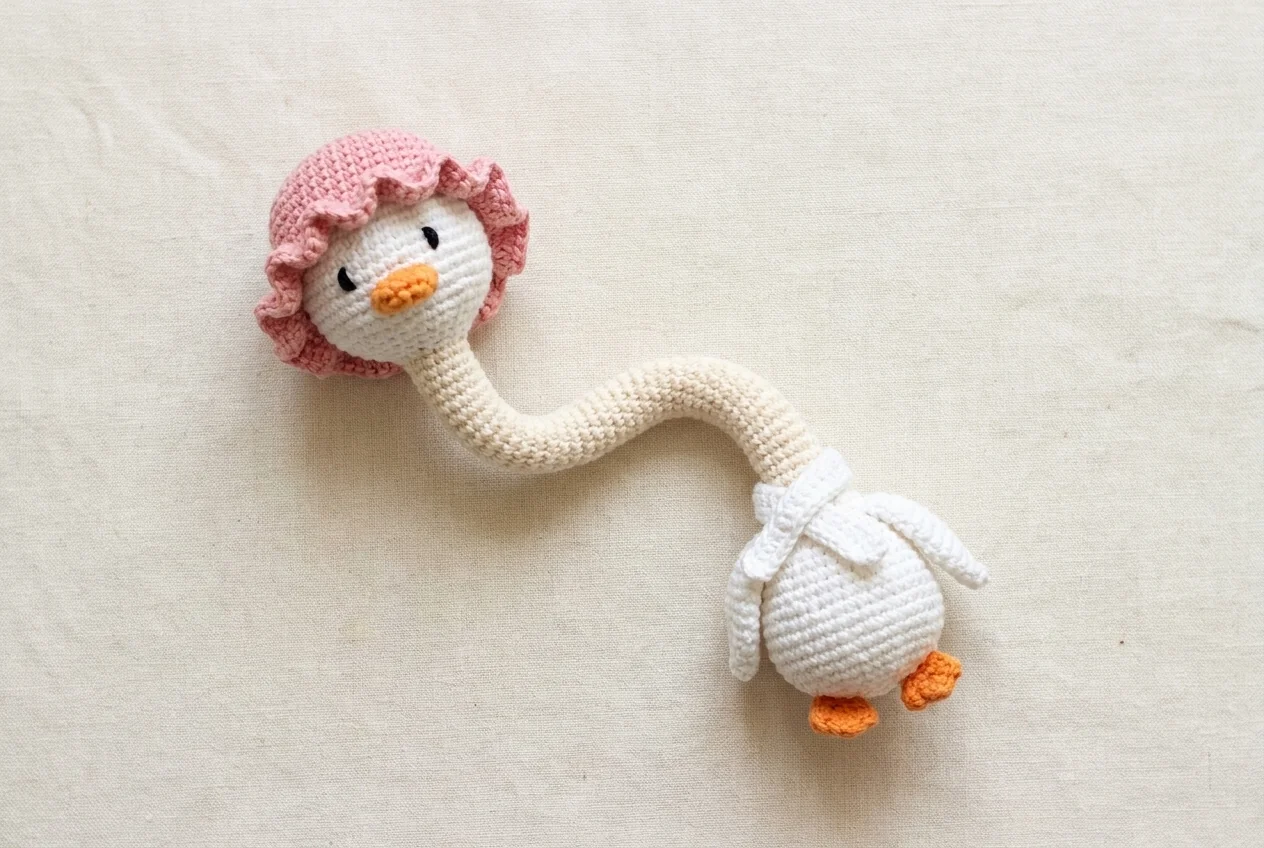
Shape the white duck crochet pattern neck gradually into a loose display curve. Avoid tight kinks or repeated twisting, and do not use the neck as a load-bearing handle. The source does not supply a tested keyring attachment, hanging loop or bag-fastening method.
- Feel gently along the supported neck for sharp or protruding wire. Remove the charm from use if any end presses against the fabric.
- Check the wings, beak, scarf, hat and feet for loose seams. Embroidered eyes do not make the wired ornament child-safe.
- Keep the finished charm away from young children and pets. Do not hang it where it could obstruct a driver’s view.
- Spot-clean according to the yarn label. Avoid soaking or machine-washing an assembled wired charm unless all materials are suitable.
White Duck Crochet Pattern: Editorial Count Notes
These notes distinguish the white duck crochet pattern source from the arithmetic-consistent alternatives above. They preserve the stated final counts but do not establish exact intended stitch placement. No physical crochet test or designer confirmation has been obtained; sample the shaping before presenting the guide as tested.
| Source line | Printed issue | Alternative used |
|---|---|---|
| Head R3 | [6 sc, inc] × 1 does not take 12 stitches to 18. | [sc, inc] × 6. |
| Head R5 | The listed 6-sc increase groups do not consume the preceding 18 stitches correctly. | [2 sc, inc] × 6: 18 → 24. |
| Head R8–9 | Printed decrease groups conflict with 24 → 18 → 12. | [2 sc, dec] × 6; [sc, dec] × 6. |
| Head R10–11 | [3 sc, dec] × 1 does not use 12 / 9 stitches to make 9 / 6. | [2 sc, dec] × 3; [sc, dec] × 3. |
| Body R51–52 | Printed repeats do not make 8 / 12 from the preceding totals. | [2 sc, inc] × 2; [sc, inc] × 4. |
| Body R53–54 | Printed 6-sc increase groups conflict with 12 → 18 → 24. | [sc, inc] × 6; [2 sc, inc] × 6. |
| Body R56–57 | The listed increase groups do not produce 28 / 32 from 24 / 28. | [5 sc, inc] × 4; [6 sc, inc] × 4. |
| Body R59–60 | Printed decreases do not reconcile 32 → 28 → 24. | [6 sc, dec] × 4; [5 sc, dec] × 4. |
| Body R61–62 | Printed [6 sc, dec] × 1 conflicts with 24 → 18 → 12. | [2 sc, dec] × 6; [sc, dec] × 6. |
| Body R63 | [4 sc, dec] × 1 does not reduce 12 to 8. | [sc, dec] × 4. |
| Wings / feet | Wing return side is unstated; the feet photos show shaping not written in the foot line. | Opposite-side wing route is disclosed; simple strip feet are preserved. |
Quick troubleshooting
| What you notice | What to check |
|---|---|
| Neck widens | Count six sc only; exclude the setup chain and joining slip stitch. |
| Head or body shaping will not fit | Return to the starred alternative and the preceding stitch total. |
| Hat ruffle is too sparse | Work 3 dc in each of 24 front loops, giving 72 dc. |
| Wing runs out of chains | After 3 sc in the last chain, return along the unused side of the same foundation. |
| Feet do not resemble the photo toes | The source only supplies 2 sc and 5 sl st along ch 8; toe shaping is missing. |
| Bottom closure leaves a gap | Check stuffing and reinforce the edge with the sewing tail rather than hiding the gap under a foot. |
| Wire feels sharp | Stop using the ornament and repair or remove the support safely. |
White Duck Crochet Pattern FAQ
Is this white duck crochet pattern beginner-friendly?
It uses familiar US stitches, but the small joined rounds, wire support and unconfirmed shaping alternatives make it better for confident beginners or intermediate makers. Review the count notes and make a sample before treating it as a tested design.
What hook and yarn does the pattern use?
The supplied color chart lists 4-ply milk cotton and a 1.8 mm hook for the Little White Duck. Use white or cream, pink and orange, plus black yarn if embroidering the eyes.
How many plain neck rounds are there?
Rounds 12–50 contain 39 plain joined rounds, each with six sc. Round 11 is the narrowing round and is not included in that tally.
Do I stuff the neck?
No. The general instructions leave the wired neck unstuffed. Fill the head and body while their openings are still accessible.
How far apart are the eyes?
The source says to leave three stitches between them but gives no numbered placement round. If using safety eyes, fit their washers before stuffing and narrowing the head.
How many stitches are in the hat ruffle?
The final hat round works 3 dc in each of 24 front loops, producing 72 dc. Its starting chain and joining slip stitch do not count as dc.
Does this white duck crochet pattern include the photographed toe shapes?
No complete toe-shaping instructions are supplied. The written feet are ch 8 followed by 2 sc and 5 sl st. The guide preserves those strips and flags the gap rather than inventing verified toe branches.
Should the scarf be white or pink?
The written scarf instructions specify white yarn and one row of 25 sc from ch 26. Pink would be a color variation; the photos do not supply a separate pink-bow pattern.
Are the starred rounds confirmed corrections?
No. They are arithmetic-consistent editorial alternatives, not physically tested or designer-confirmed corrections. They may change shaping relative to the designer’s intention.
How large is the finished duck?
The supplied pages give no finished dimensions, gauge or yarn quantity. Yarn thickness, tension, neck length and the final curve affect the result; measure your own sample.
Where can I browse PDF crochet patterns?
Use the store button below and review each listing before buying. This guide does not assert that a particular duck PDF, price or bundle is currently available.
Keep your white duck crochet pattern notes with the finished sample, especially any confirmed shaping changes. Clear counts, safe wire enclosure and secure seams are more important than forcing incomplete instructions to match a reference photograph.