Don't miss our Offers - up to 50% OFF!

Funny Crochet Animals: Duck, Frog, Blue Fish and Pink Cat
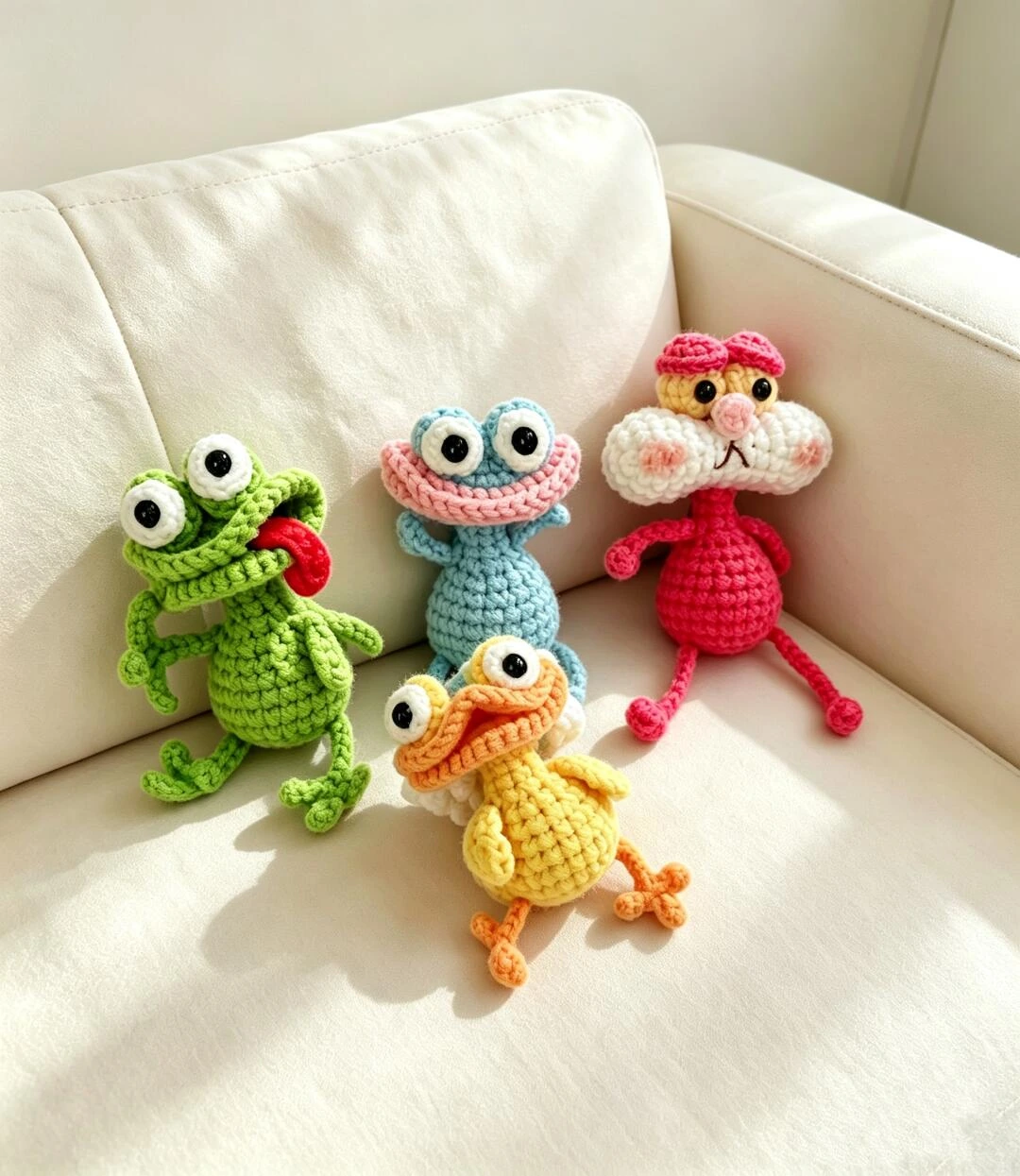
Big eyes, wobbly limbs and wonderfully silly faces give these funny crochet animals their personality. Choose a yellow duck with an orange bill, a bright green frog with a red tongue, a blue fish with an oversized pink smile, or a pink cat with a sculpted white muzzle. The four characters use a similar small pear-shaped body, then change the face, colors and appendages.
This guide translates the supplied Chinese pattern notes into US crochet terms and pairs them with the original finished-project photographs. Four newly typeset English pattern cards are included below. They contain no Chinese text; the source credit is retained in English.
1. Funny Crochet Animals: Materials and Colors
Use a smooth yarn that lets you see the stitches clearly. Choose a hook that produces close single-crochet fabric without making your hands strain. The source mentions a 2.5 mm hook for the simple eye disks, but does not establish the hook for every part, the yarn weight, fiber, gauge or finished height. Keep the body and head yarns similar in thickness; use the photos as color references, not size measurements.
| Character | Colors to prepare |
|---|---|
| Duck | Yellow body and head; orange bill and feet; white eyes; black pupils. |
| Frog | Green body, head and limbs; red tongue; white eyes; black pupils. |
| Blue fish | Blue body, head and fins; pink mouth rim; white eyes; black pupils. |
| Pink cat | Pink body, lids and limbs; yellow eye pieces; white muzzle; pale pink nose; black pupils and dark embroidery. |
- Toy stuffing, a stitch marker, blunt tapestry needle, scissors and temporary placement markers.
- Matching yarn for sewing each piece; leave suitable tails when fastening off.
- Black embroidery yarn for pupils and facial details. The glossy hard pupils in the references are not required.
No yarn quantity is supplied. Have enough of the main color for a trial body, head and any reworking. For a different finished size, change yarn and hook together and make a sample; adding random rounds changes the proportions and the neck join.
2. Read the Stitch Notation in US Terms
| Notation | Meaning used here |
|---|---|
| MR / ring start | Magic ring. Secure the starting end before stuffing. |
| x / sc | US single crochet. |
| v / inc | 2 sc in one stitch. |
| a / dec | Single-crochet decrease over 2 stitches. |
| t / hdc | US half double crochet; a conventional reading of the source shorthand. |
| f / dc | US double crochet; used for the cat’s three-dc clusters. |
| ch / sl st | Chain / slip stitch. Count a return from the hook, not from the beginning of the chain. |
| (sequence) × n | Repeat the sequence n times. Final column shows the resulting stitch count. |
The source does not supply a full stitch legend. The x/v/a and t/f readings follow common Chinese amigurumi notation and the surrounding instructions, but they are not designer-confirmed. Work the round-based pieces in continuous rounds unless instructed otherwise; joining at each round is not specified. Mark the first stitch and check the count before moving on.
3. Crochet the Shared Pear-Shaped Body
Use yellow for the duck, green for the frog, blue for the fish and pink for the cat. Start at the rounded bottom and work upward toward the narrow neck. The following body sequence agrees across the clearer frog, fish and cat sheets; the duck correction is explained underneath.
| Rnd | Instructions | Sts |
|---|---|---|
| 1 | 8 sc in MR. | 8 |
| 2 | Inc × 8. | 16 |
| 3 | (Sc, inc) × 8. | 24 |
| 4–5 | Sc around for 2 rounds. | 24 |
| 6 | (Sc, dec, sc) × 6. | 18 |
| 7 | Sc around. | 18 |
| 8 | (Sc, dec) × 6. | 12 |
| 9 | Sc around. | 12 |
| 10 | Dec × 6. | 6 |
| 11 | Dec × 3; close remaining 3 sts. | 3 |
Stuff gradually after the wider belly has formed and before the neck opening becomes too small. Keep the lower body rounded but not hard. After R11, draw the tail through the remaining three stitches and close gently. Leave a sewing tail if useful. This final closure and the sewing method are finishing guidance; the sheets list the rounds without a full stuffing or assembly tutorial.
Mark the lower body between R3 and R4 for the legs. Mark the upper body for the arms: the duck note points to R8–R9; the blue fish and pink cat point to R9–R10. The frog arm note is inconsistent, so use a temporary upper-body placement around R8–R9 and adjust against the reference before sewing.
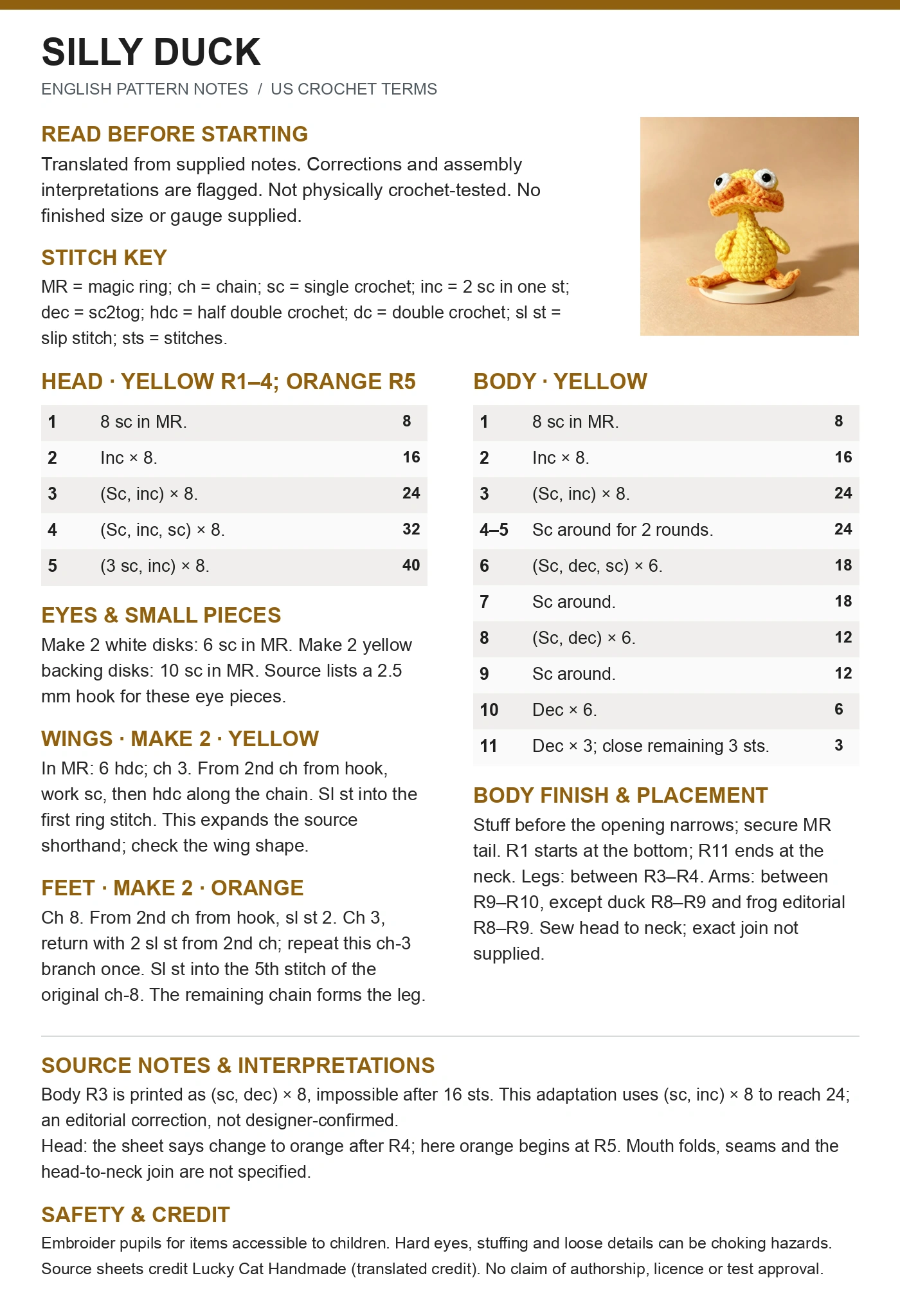
4. Funny Crochet Animals: Silly Duck
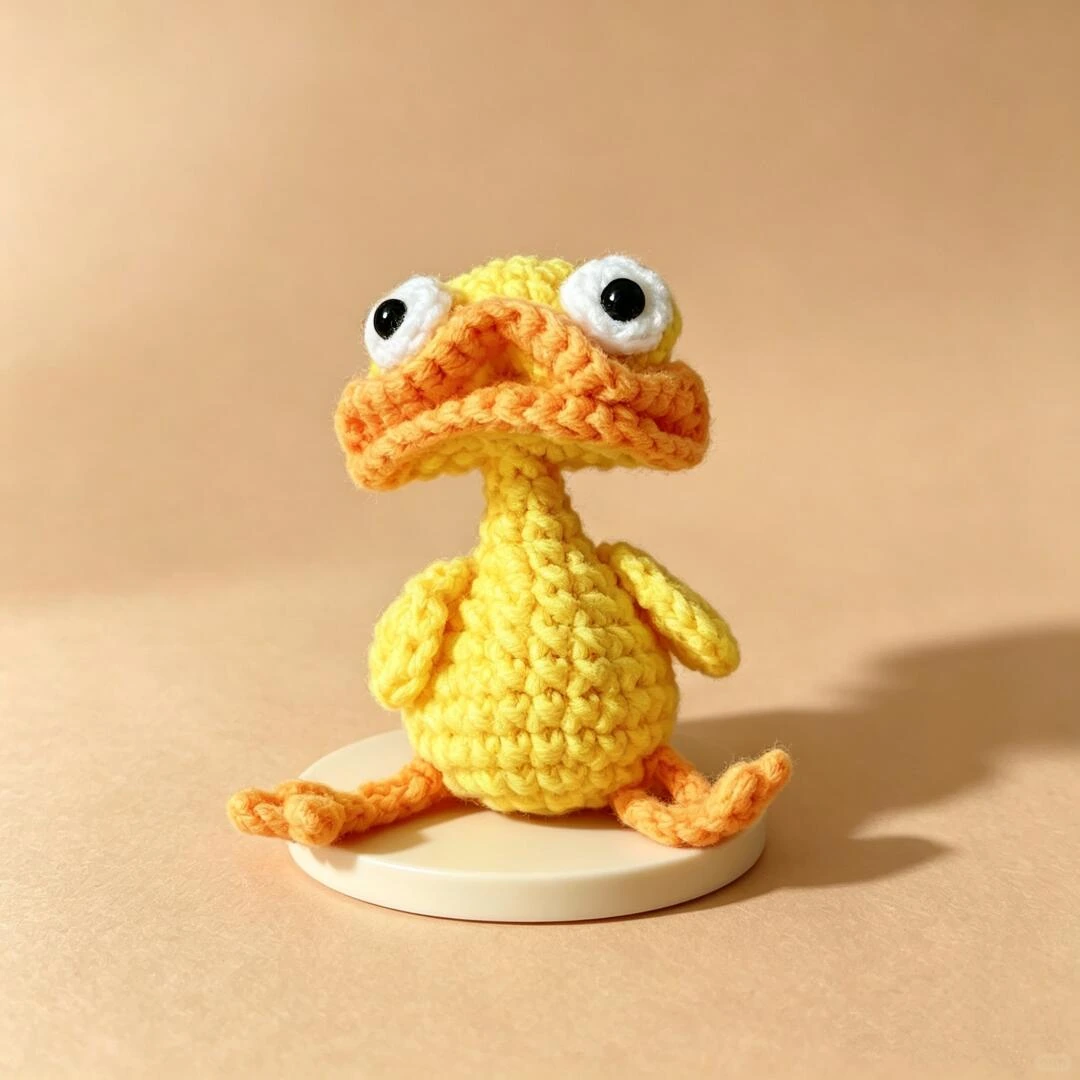
Work the head as a separate expanding cup. Color plan: Yellow R1–4; orange R5. The source gives five head rounds, ending at an open rim. It does not instruct you to add a second identical head, close the whole rim or work additional head rounds.
| Rnd | Head instructions | Sts |
|---|---|---|
| 1 | 8 sc in MR. | 8 |
| 2 | Inc × 8. | 16 |
| 3 | (Sc, inc) × 8. | 24 |
| 4 | (Sc, inc, sc) × 8. | 32 |
| 5 | (3 sc, inc) × 8. | 40 |
Eyes and small face pieces
Make 2 white disks: 6 sc in MR. Make 2 yellow backing disks: 10 sc in MR. Source lists a 2.5 mm hook for these eye pieces.
Finish each eye disk with a sewing tail. Place a white disk against a larger main-color backing and pin both eyes above the upper mouth edge. The sheets do not give an additional eye-stalk tube or a precise joining seam: align the pieces to the reference and secure their edges carefully. Embroidered black pupils avoid separate hard fittings.
Wings · make 2 · yellow
In MR: 6 hdc; ch 3. From 2nd ch from hook, work sc, then hdc along the chain. Sl st into the first ring stitch. This expands the source shorthand; check the wing shape.
Feet · make 2 · orange
Ch 8. From 2nd ch from hook, sl st 2. Ch 3, return with 2 sl st from 2nd ch; repeat this ch-3 branch once. Sl st into the 5th stitch of the original ch-8. The remaining chain forms the leg.
The branching chain construction is a literal expansion of the terse source route. Keep the three digits together, check the return-chain count, and leave the longer unworked chain as the limb attachment strand. Fasten off with a sewing tail. Avoid pulling the slip stitches so tight that the digits curl into hard knots.
5. Funny Crochet Animals: Silly Frog
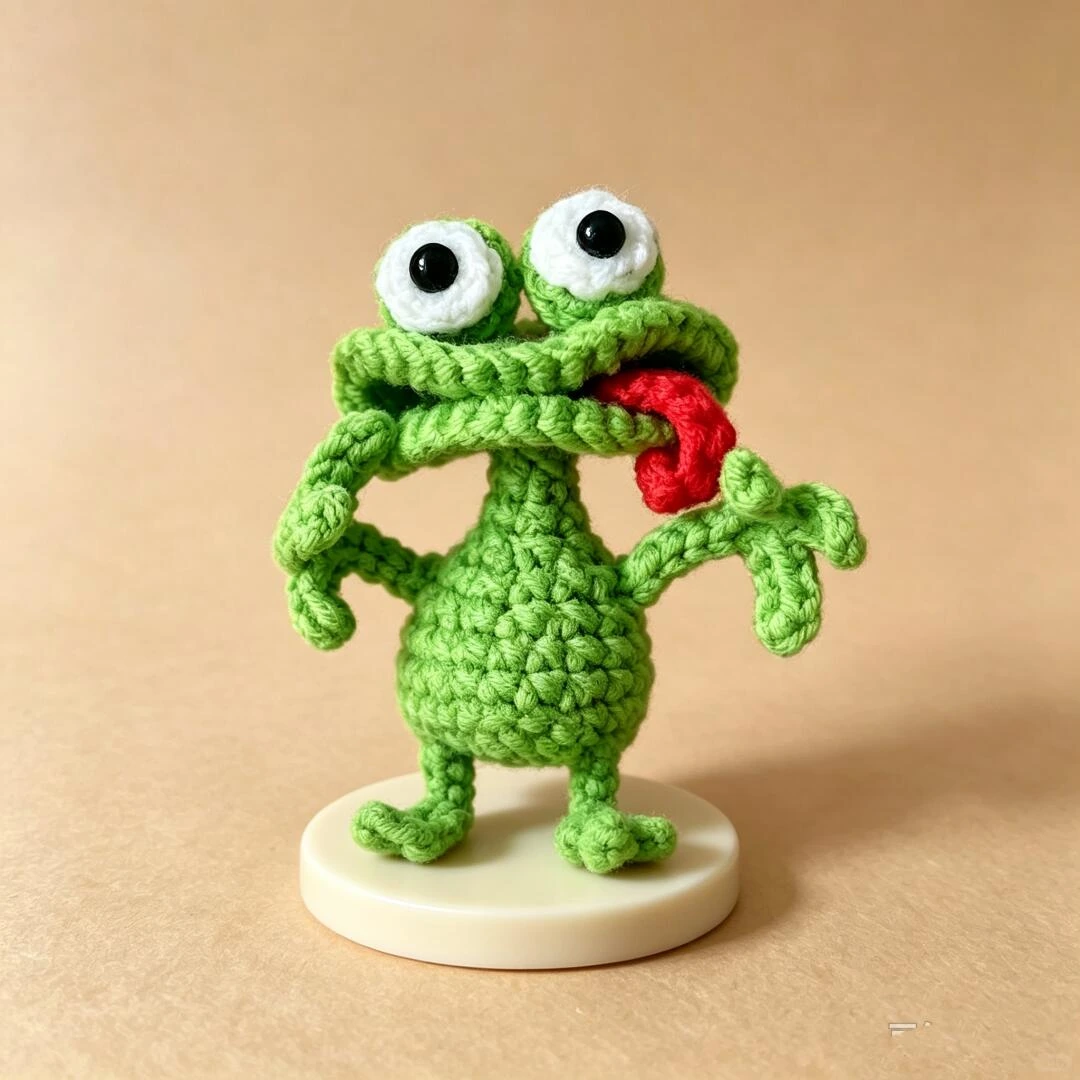
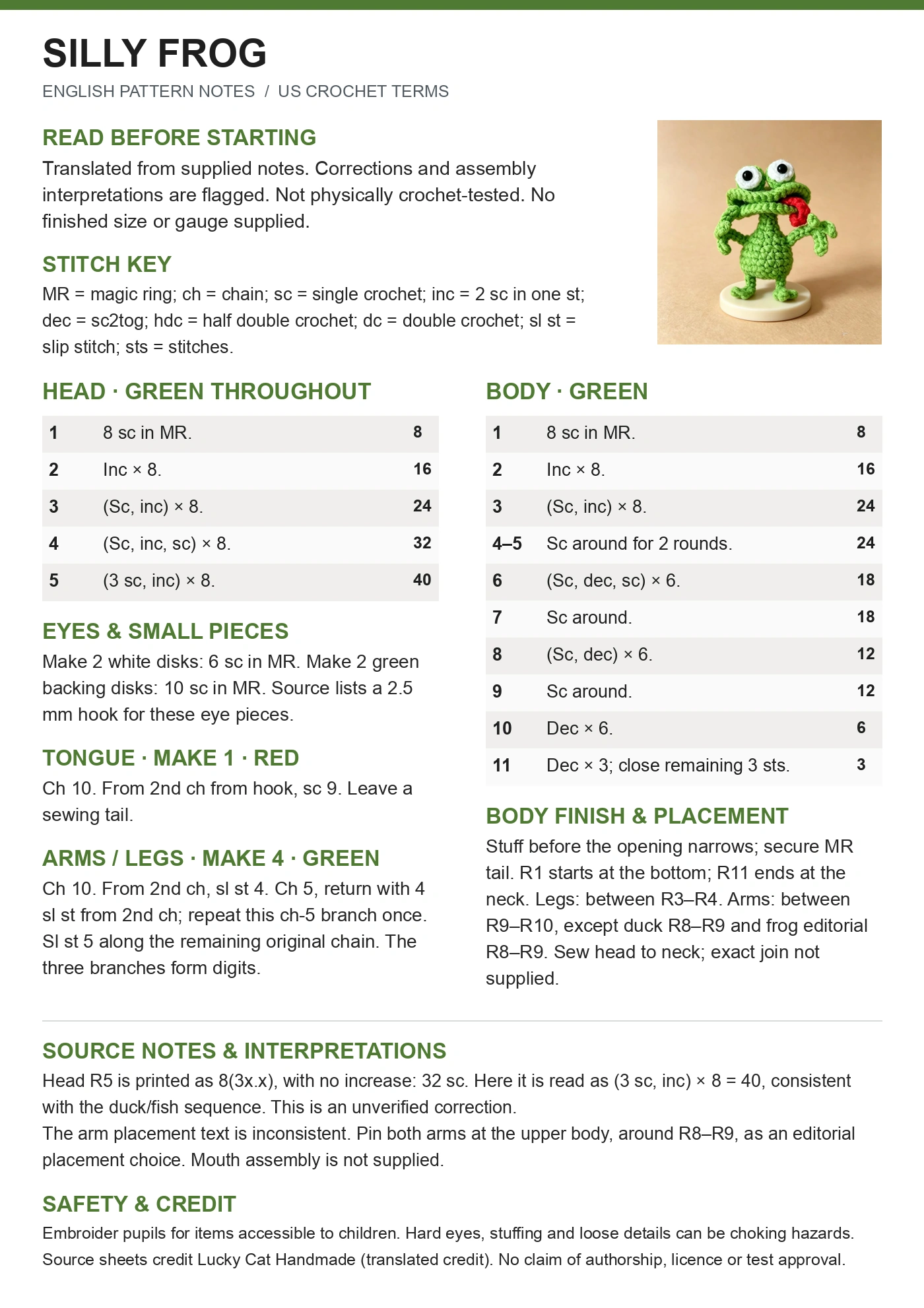
Work the head as a separate expanding cup. Color plan: Green throughout. The source gives five head rounds, ending at an open rim. It does not instruct you to add a second identical head, close the whole rim or work additional head rounds.
| Rnd | Head instructions | Sts |
|---|---|---|
| 1 | 8 sc in MR. | 8 |
| 2 | Inc × 8. | 16 |
| 3 | (Sc, inc) × 8. | 24 |
| 4 | (Sc, inc, sc) × 8. | 32 |
| 5 | (3 sc, inc) × 8. | 40 |
Eyes and small face pieces
Make 2 white disks: 6 sc in MR. Make 2 green backing disks: 10 sc in MR. Source lists a 2.5 mm hook for these eye pieces.
Finish each eye disk with a sewing tail. Place a white disk against a larger main-color backing and pin both eyes above the upper mouth edge. The sheets do not give an additional eye-stalk tube or a precise joining seam: align the pieces to the reference and secure their edges carefully. Embroidered black pupils avoid separate hard fittings.
Tongue · make 1 · red
Ch 10. From 2nd ch from hook, sc 9. Leave a sewing tail.
Arms / legs · make 4 · green
Ch 10. From 2nd ch, sl st 4. Ch 5, return with 4 sl st from 2nd ch; repeat this ch-5 branch once. Sl st 5 along the remaining original chain. The three branches form digits.
The branching chain construction is a literal expansion of the terse source route. Keep the three digits together, check the return-chain count, and leave the longer unworked chain as the limb attachment strand. Fasten off with a sewing tail. Avoid pulling the slip stitches so tight that the digits curl into hard knots.
6. Funny Crochet Animals: Blue Fish
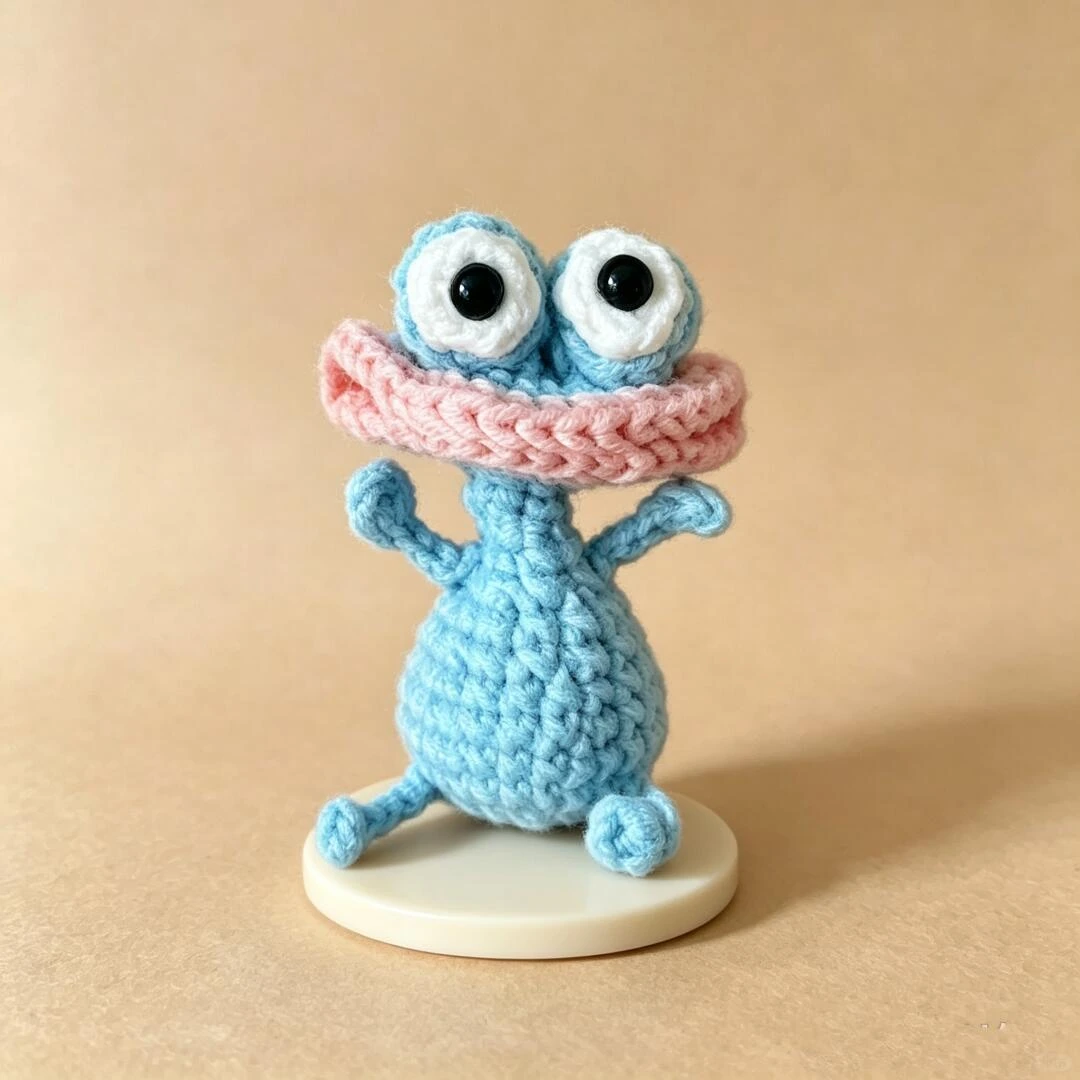
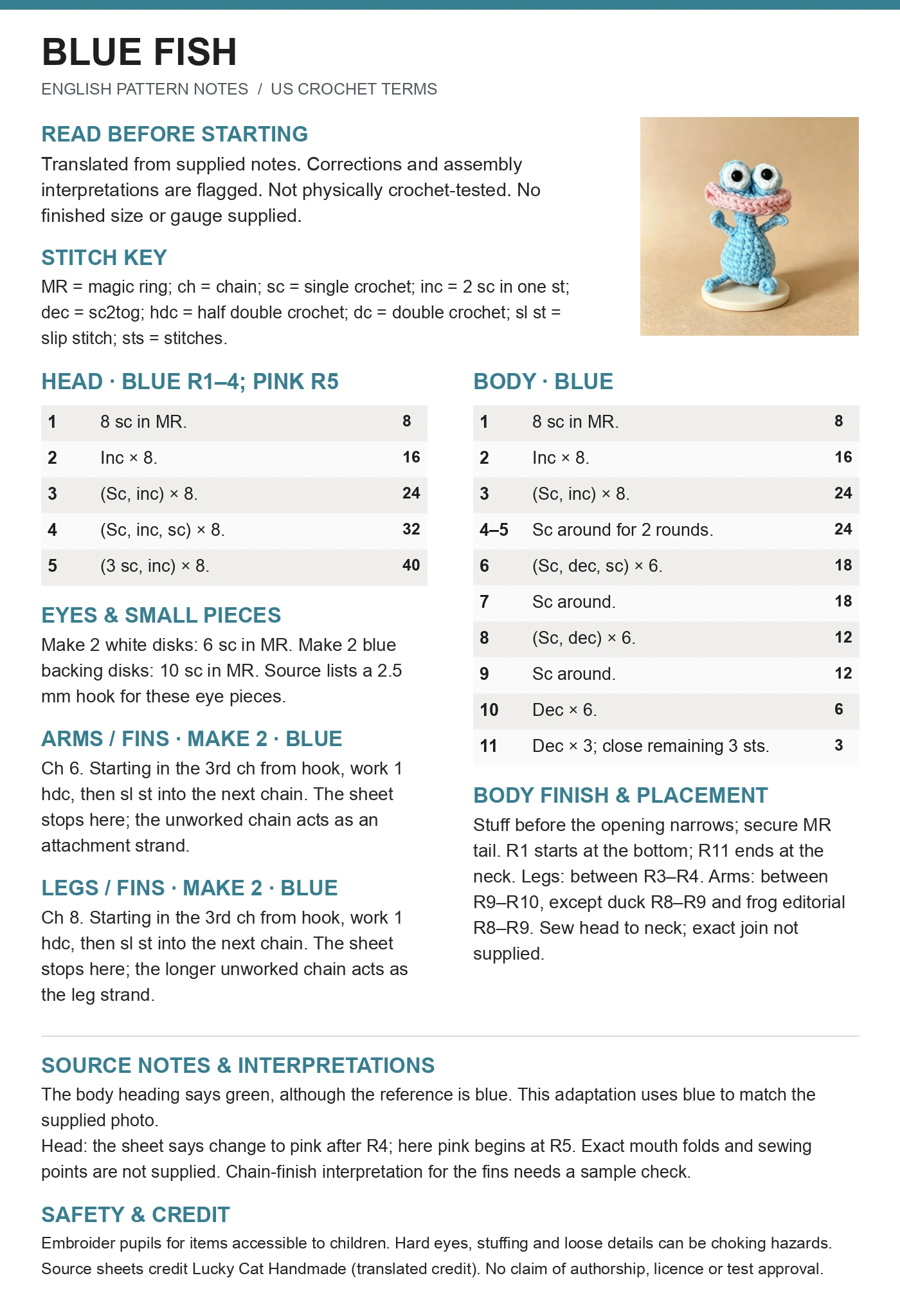
Work the head as a separate expanding cup. Color plan: Blue R1–4; pink R5. The source gives five head rounds, ending at an open rim. It does not instruct you to add a second identical head, close the whole rim or work additional head rounds.
| Rnd | Head instructions | Sts |
|---|---|---|
| 1 | 8 sc in MR. | 8 |
| 2 | Inc × 8. | 16 |
| 3 | (Sc, inc) × 8. | 24 |
| 4 | (Sc, inc, sc) × 8. | 32 |
| 5 | (3 sc, inc) × 8. | 40 |
Eyes and small face pieces
Make 2 white disks: 6 sc in MR. Make 2 blue backing disks: 10 sc in MR. Source lists a 2.5 mm hook for these eye pieces.
Finish each eye disk with a sewing tail. Place a white disk against a larger main-color backing and pin both eyes above the upper mouth edge. The sheets do not give an additional eye-stalk tube or a precise joining seam: align the pieces to the reference and secure their edges carefully. Embroidered black pupils avoid separate hard fittings.
Arms / fins · make 2 · blue
Ch 6. Starting in the 3rd ch from hook, work 1 hdc, then sl st into the next chain. The sheet stops here; the unworked chain acts as an attachment strand.
Legs / fins · make 2 · blue
Ch 8. Starting in the 3rd ch from hook, work 1 hdc, then sl st into the next chain. The sheet stops here; the longer unworked chain acts as the leg strand.
The source only names one hdc and one slip stitch after the chain start; it does not tell you to fill every remaining chain. Keeping the rest as an attachment strand is an editorial interpretation. Make one fin first and compare its length with the body before making its partner.
7. Funny Crochet Animals: Pink Cat
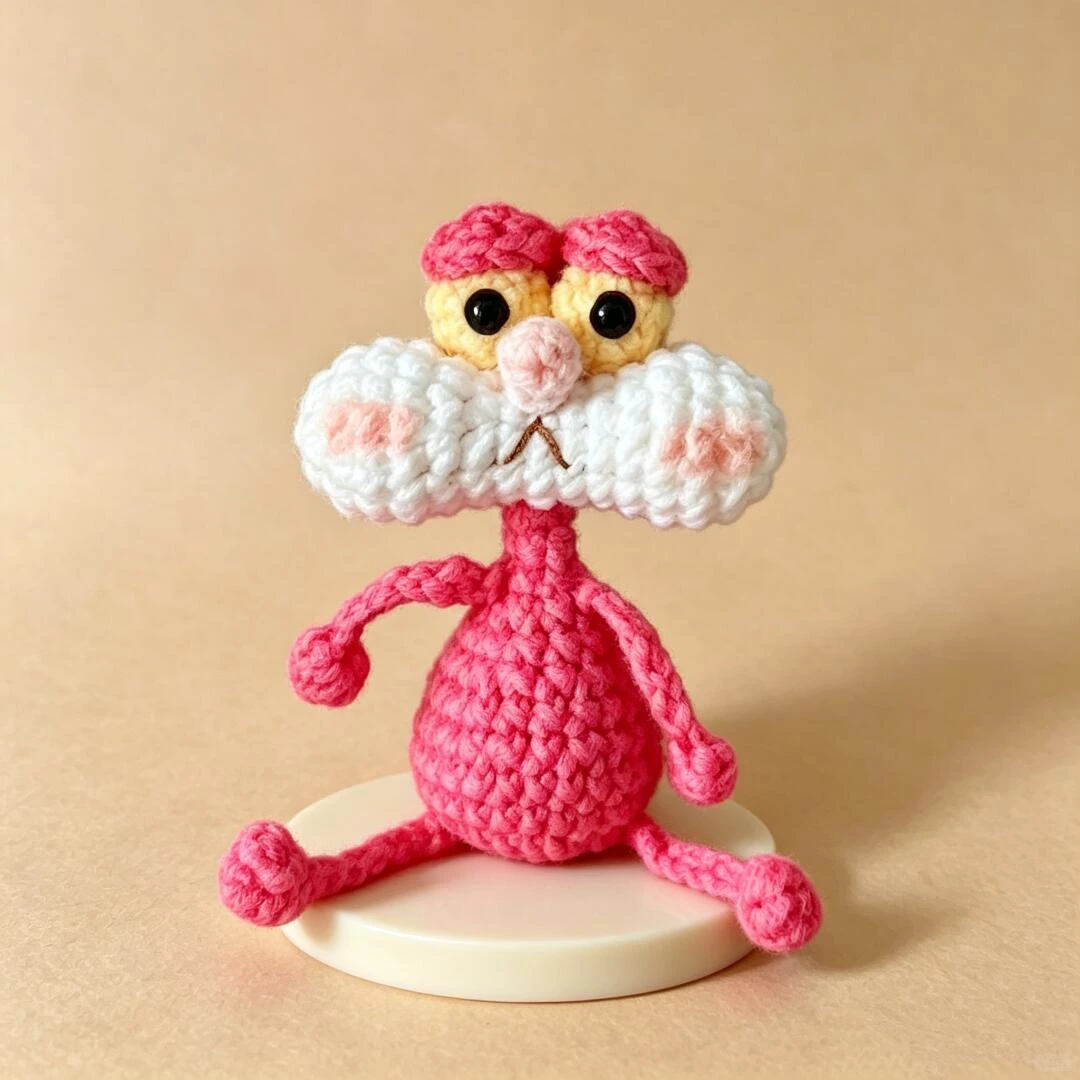
The pink cat differs from the other characters: it has a long, shaped white muzzle rather than a five-round mouth cup. The source title refers to a Pink Panther-style character; the descriptive name used here does not imply an official or licensed pattern. Make one continuous muzzle piece, with the narrow middle under the nose and rounded ends at both sides.
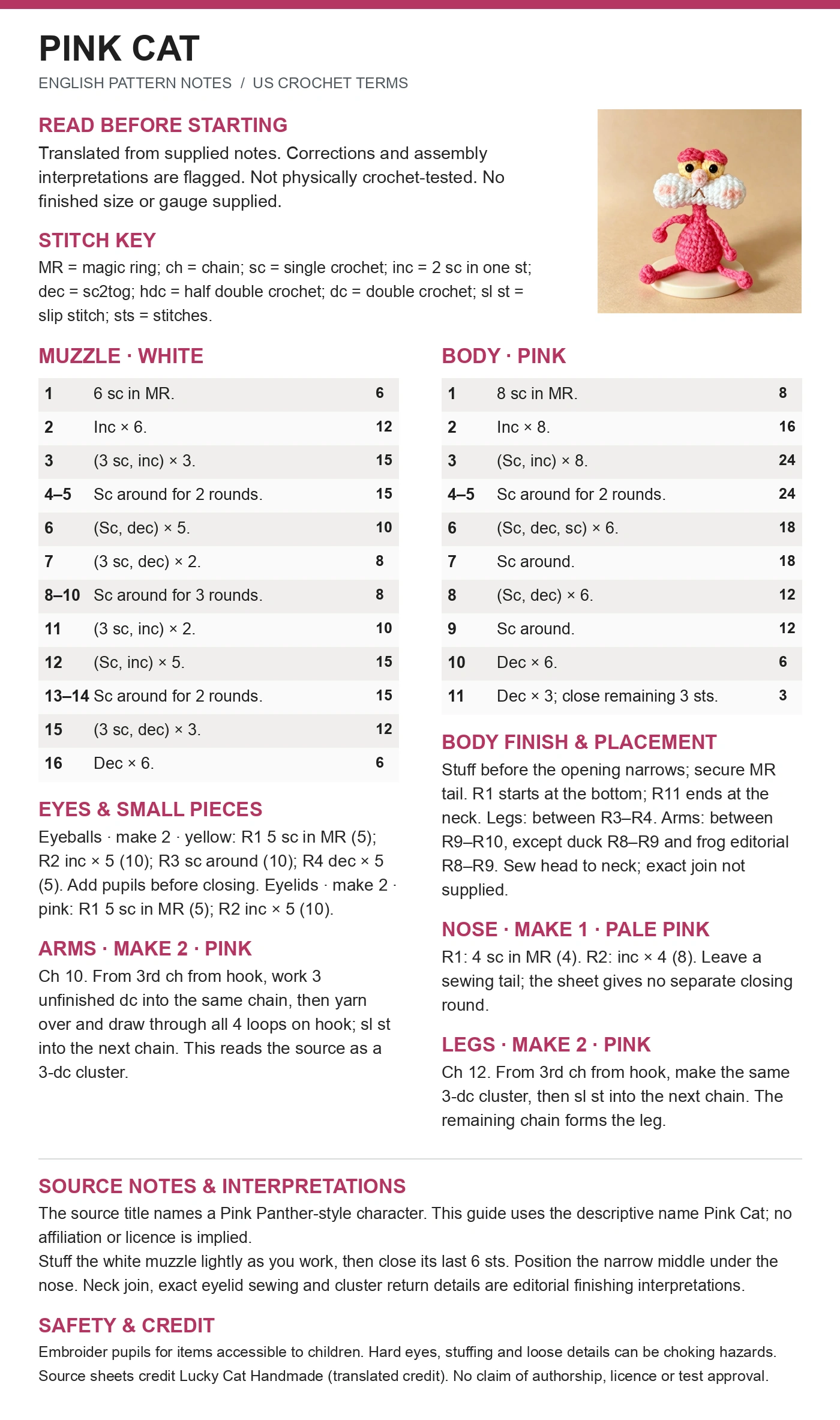
| Rnd | White muzzle instructions | Sts |
|---|---|---|
| 1 | 6 sc in MR. | 6 |
| 2 | Inc × 6. | 12 |
| 3 | (3 sc, inc) × 3. | 15 |
| 4–5 | Sc around for 2 rounds. | 15 |
| 6 | (Sc, dec) × 5. | 10 |
| 7 | (3 sc, dec) × 2. | 8 |
| 8–10 | Sc around for 3 rounds. | 8 |
| 11 | (3 sc, inc) × 2. | 10 |
| 12 | (Sc, inc) × 5. | 15 |
| 13–14 | Sc around for 2 rounds. | 15 |
| 15 | (3 sc, dec) × 3. | 12 |
| 16 | Dec × 6. | 6 |
Add small amounts of stuffing as each rounded end develops, keeping the middle flexible. After R16, use the tail to close the remaining six stitches. The stuffing schedule and closure are editorial finishing guidance. Pin the muzzle across the top of the body before adding the nose and eyes.
Eyes and small face pieces
Eyeballs · make 2 · yellow: R1 5 sc in MR (5); R2 inc × 5 (10); R3 sc around (10); R4 dec × 5 (5). Add pupils before closing. Eyelids · make 2 · pink: R1 5 sc in MR (5); R2 inc × 5 (10).
Sew each pink lid along the upper edge of a yellow eyeball without covering the pupil. Leave the lower yellow portion visible. The source does not provide an exact eyelid attachment map. Position the pale pink nose at the muzzle center, then embroider the short dark mouth lines to match the reference expression.
Nose · make 1 · pale pink
R1: 4 sc in MR (4). R2: inc × 4 (8). Leave a sewing tail; the sheet gives no separate closing round.
Arms · make 2 · pink
Ch 10. From 3rd ch from hook, work 3 unfinished dc into the same chain, then yarn over and draw through all 4 loops on hook; sl st into the next chain. This reads the source as a 3-dc cluster.
Legs · make 2 · pink
Ch 12. From 3rd ch from hook, make the same 3-dc cluster, then sl st into the next chain. The remaining chain forms the leg.
For each three-dc cluster: yarn over, insert into the chosen chain, draw up a loop, yarn over and draw through two loops; repeat that unfinished dc twice more in the same chain, then yarn over and draw through all four loops. Chain lengths include the two skipped starting chains. Leave the unworked chain as the thin limb, rather than filling it with extra dc not named in the source.
8. Assemble the Faces, Head and Limbs
Treat the following as editorial assembly guidance, not a translated seam diagram. The three wide-mouth sheets do not show how the five-round cup is folded, where the mouth corners are sewn, or exactly how it meets the neck. The photos show the desired expression but do not document the hidden construction.
- Pin the head cup above the narrow body neck. Shape the colored edge into an upper and lower lip using temporary stitches, leaving a broad horizontal opening. Compare the front and side views before committing to a seam.
- Check that the mouth rim stays soft and that the head can sit above the neck without exposing stuffing. Do not stuff an open mouth cavity. A sample is needed to determine the final cup folds and neck seam.
- Position the eye pieces close together along the upper mouth edge. For the duck and fish, keep the colored mouth rim visible underneath. For the frog, curl the red tongue over one side before anchoring its base inside.
- For the cat, pin the white muzzle across the top of the neck, align the yellow eyes above it, add the pink upper lids and center nose, then embroider the mouth.
- Sew the legs between body R3–R4. Pin both arms at the stated upper-body level. Inspect the pose from several angles; the chains may hang loosely rather than support a standing toy.
- Remove every pin and temporary marker. Secure sewing ends inside sound fabric, not only in a single chain loop.
A display stand is shown in several photos, but the source gives no stand pattern or weighted base. Do not add loose weights or wire to make the figure stand. A seated pose or a separate stable adult display support is preferable to inventing an untested internal structure.
9. Troubleshoot Your Funny Crochet Animals
| Problem | What to check |
|---|---|
| Body count is wrong after R3 | Use (sc, inc) × 8 to go from 16 to 24. The duck source has a decrease typo. |
| Frog mouth is smaller than the others | The printed R5 has no increase. This adaptation uses (3 sc, inc) × 8 to reach 40; confirm that correction with a sample. |
| Body color looks wrong on the fish | The source body heading says green; the supplied reference and this guide use blue. |
| Mouth will not match the photo | The head cup counts alone do not define the folds or hidden seam. Re-pin before sewing; do not assume added rounds will fix it. |
| Limbs are too thick | Keep the chain strands thin. Do not fill every unworked chain unless the source actually instructs it. |
| Eyes pull the face out of shape | Use lighter stuffing and distribute the sewing stitches. Hard pupils must be installed before a closed eye piece becomes inaccessible. |
| Stuffing shows | Check yarn/hook compatibility and tension. Overstuffing spreads stitches even if the counts are correct. |
Count checks confirm numerical consistency, not the actual appearance of a finished sample. The source-dependent corrections, mouth assembly and small chain-return interpretations should be tested together before you describe a final pattern as reliable or sell items made from this adaptation.
10. Finish, Display and Care
Compare the paired eyes, arms and legs before tying off the final tails. Inspect the neck seam, tongue attachment, muzzle edges and every chain digit. The finished piece should have no exposed filling, loose hard components, pins, long unsecured floats or dangling sewing ends.
Safety: the reference uses glossy hard eyes. Such eyes are not automatically safe for children, even if sold as safety eyes. Embroider pupils for items that children may access, and do not assume this untested decorative design meets toy-safety requirements. Small parts, loose stitching and escaped stuffing can be choking hazards. Keep decorative samples away from babies and unattended young children.
Follow the actual yarn and filling care instructions. If washing is appropriate, use a gentle method, reshape the mouth and limbs while damp, and dry fully. Do not promise machine-washability when the fiber and fittings are unknown. Recheck seams and facial details after cleaning.
Funny Crochet Animals FAQ
Are these funny crochet animals beginner-friendly?
The round sequences are short, but the mouth shaping and several terse chain instructions need experience and a willingness to sample. This is not a complete beginner-tested tutorial.
Are all four bodies the same?
Yes, this guide uses the shared 8, 16, 24, 24, 24, 18, 18, 12, 12, 6, 3 progression. The duck R3 is an explicitly marked correction.
What hook size should I use?
The source specifies 2.5 mm beside the simple eye disks. It does not establish a universal hook size or yarn weight for the whole project. Test a hook that gives close fabric with your yarn.
What size will the finished animals be?
No verified height, gauge or yarn usage is supplied. The photos do not provide a reliable size scale.
Why is frog head R5 changed?
The source prints 8(3x.x), yielding 32 sc without increasing. This guide interprets the last symbol as an increase to reach 40, following the duck and fish progression. That correction still needs a physical test.
Are the English cards exact translations?
They translate the readable sequences and include clearly marked editorial corrections, stitch-key interpretations and finishing advice. They are not presented as designer-confirmed instructions.
Can I use hard plastic eyes?
The photos show hard eyes, but this guide recommends embroidered pupils where children could access the item. No hardware makes an untested decorative pattern automatically toy-safe.
Do the store buttons download these four patterns?
No. They open the general PDF pattern collection. Check the actual store listings; a matching PDF for these exact designs is not promised.
Source and Publication Notes
The four supplied Chinese instruction sheets carry a creator credit translated here as Lucky Cat Handmade. This guide and the English cards do not claim original authorship, permission to republish, physical testing or official character licensing. Confirm photo, design and character rights before commercial publication or sales. The supplied finished-project photos are reference images, not newly generated construction photographs.
Make the count corrections explicit, keep the English source notes with the cards, and test the assembled shape before sharing a final written pattern. For more handmade-project ideas, visit UniverseCrochet.